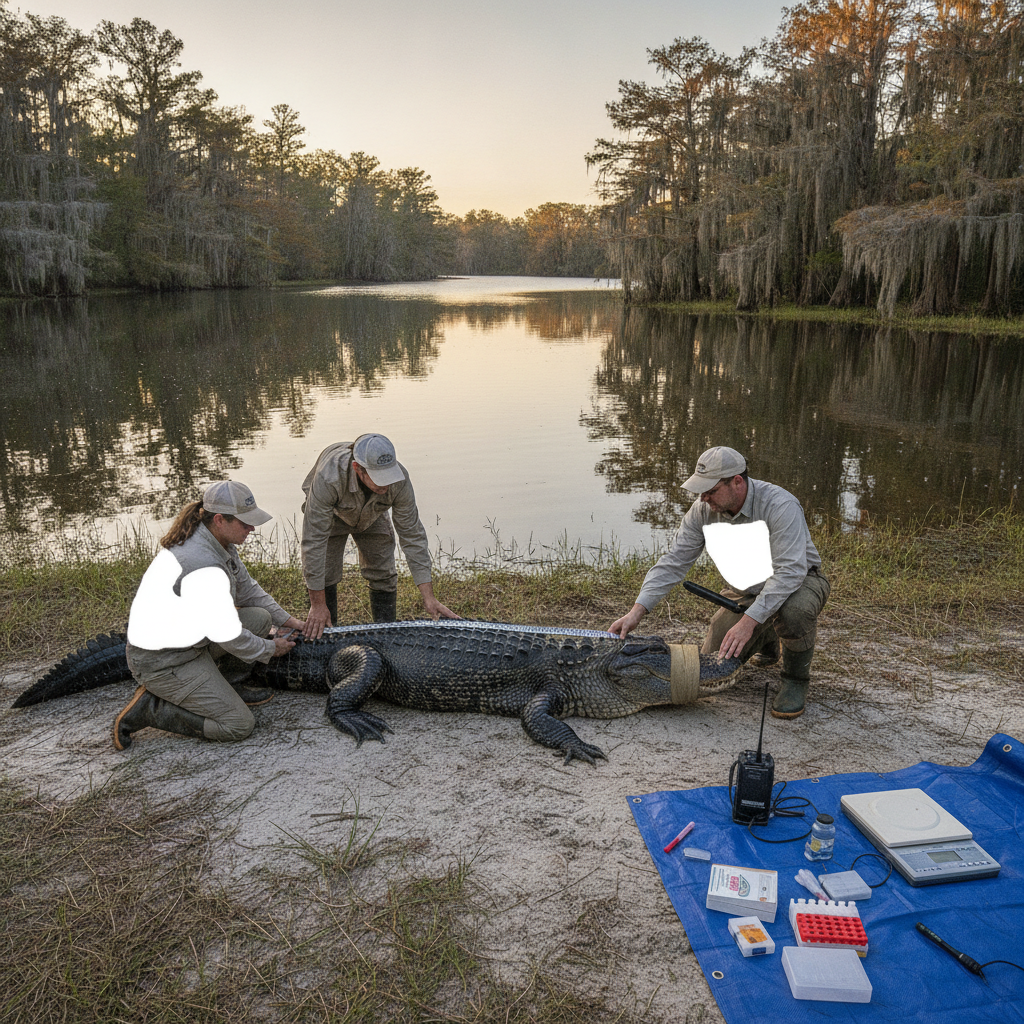
Researchers are actively monitoring several hundred alligators in Par Pond, a 2,300-acre reservoir on the Savannah River Site, to track the long-term environmental impact of past nuclear operations. This ongoing catch-test-release program, conducted by the University of Georgia’s Savannah River Ecology Laboratory, leverages the alligators’ long lifespans and position at the top of the food web to provide a continuous record of the lake’s contamination levels. The latest findings indicate a significant reduction in radioactivity in the animals, reflecting decades of remediation efforts, though mercury levels remain a concern.
Par Pond was constructed in 1958 by the U.S. government to cool the P and R plutonium production reactors at the Savannah River Site, a 310-square-mile reservation in South Carolina that produced plutonium and tritium for the Cold War arsenal. While the reactors have been decommissioned for decades, the lake now hosts a dense population of American alligators. The government’s initial seizure of land in the early 1950s, which led to the eviction of farming communities and the fencing of the site, inadvertently created a large nature reserve. This protected environment, combined with the warm reactor-cooling reservoirs, provided an ideal habitat for alligators, which were not previously common in the region.
The sediments of Par Pond contain a historical record of the Cold War era, including radioactive cesium-137 from reactor operations and mercury introduced from the Savannah River. While much of this contamination typically remains in the lakebed, a precautionary drawdown in 1991 to repair the Par Pond dam stirred up these buried sediments, making mercury bioavailable once more. This event highlighted the potential for past contamination to re-emerge, underscoring the importance of continuous monitoring.
Alligators are considered ideal environmental monitors due to several factors: they are apex predators, concentrating substances from the food chain; they do not travel far, ensuring their chemistry reflects their specific habitat; and their long lifespans, potentially exceeding 70 years, mean a single animal can provide data spanning decades. Researchers collect blood and tail-tissue samples from captured alligators, testing them for cesium and mercury before tagging and releasing them. This method allows scientists to assess the effectiveness of cleanup programs over extended periods.
While the era of highly radioactive alligators, once nicknamed Tritagator and Dioxinator by workers, is largely over, mercury remains a persistent issue. A recent study of alligators in Par Pond and L Lake revealed average tail-muscle mercury levels above the World Health Organization’s threshold for safe consumption. This finding is particularly relevant given that South Carolina permits public alligator hunts outside the Savannah River Site fence, and alligators occasionally venture beyond the site’s boundaries. The research team combined tissue data with hunter surveys to estimate real exposure risks, demonstrating the unique insights provided by these long-term animal studies.