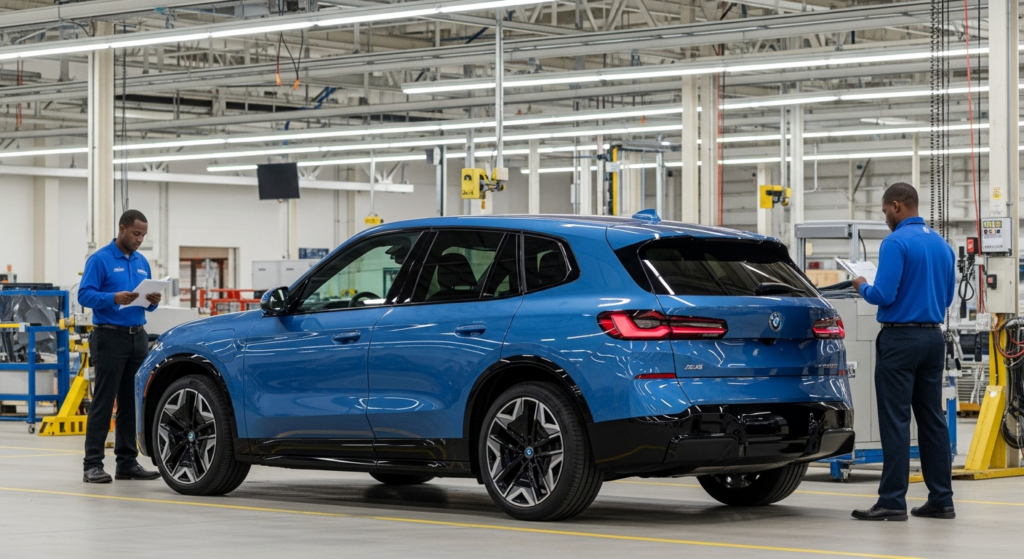
BMW announced Tuesday its intention to begin producing electric vehicles in the United States by the end of the year, a strategic decision that positions the German automaker against a backdrop of other manufacturers scaling back their investments in electric vehicle technology.
The iX5, a mid-size electric SUV, will be the first electric model to roll off the assembly line at BMW’s sprawling Spartanburg, South Carolina, facility. This plant is one of BMW’s largest and most significant production centers outside of Germany, currently serving as the primary hub for the production of its popular X5 and other SUV models. By 2030, the company aims to expand its electric vehicle output at the Spartanburg site to a total of six distinct electric models.
The iX5 is designed as an electric variant of the established X5 series, which will continue to be offered in gasoline, diesel, and plug-in hybrid configurations. This multi-powertrain strategy reflects BMW’s approach to market demand during the transition to electrification. Further expanding its electric lineup, BMW also plans to launch the smaller iX3 electric SUV in the U.S. this fall. This model is part of a broader series of updated electric vehicles that the automaker intends to introduce over the next few years.
BMW Manufacturing Co., LLC, the entity responsible for the Spartanburg operations, has historically emphasized that its X model vehicles are manufactured in South Carolina using a combination of U.S. and global components. This integrated approach highlights the complex supply chains that underpin modern automotive production and the significant economic footprint these operations create across the state.
The decision to deepen electric vehicle production in South Carolina comes at a time when the state is actively cultivating its advanced manufacturing sector. While the Spartanburg plant is located in the Upstate region, its substantial investment and long-term production goals have implications for the entire state’s economy, including the Central Savannah River Area (CSRA) and Aiken County.
Aiken, with its own robust manufacturing base, including major employers like Bridgestone Americas and Rolls-Royce Solutions America, operates within the same statewide economic ecosystem. The expansion of high-tech manufacturing, particularly in the automotive sector, can influence workforce demands, educational priorities, and the broader industrial supply chain across South Carolina. Institutions like the University of South Carolina Aiken and Aiken Technical College play a critical role in developing the skilled labor force necessary to support such advanced manufacturing initiatives, ensuring that the state remains competitive for future investments.
### Why it matters in Aiken
BMW’s commitment to electric vehicle production in South Carolina reinforces the state’s position as a hub for advanced manufacturing, a trend that holds particular relevance for Aiken. The presence of major manufacturers such as Bridgestone Americas, which produces tires for a global market, and Rolls-Royce Solutions America, specializing in diesel engines, demonstrates Aiken County’s existing capacity for sophisticated industrial operations. A thriving automotive sector elsewhere in the state can create indirect opportunities for local suppliers, logistics companies, and a demand for a highly skilled workforce. This statewide industrial growth can also influence curriculum development at institutions like the University of South Carolina Aiken and Aiken Technical College, aligning educational pathways with the evolving needs of advanced manufacturing and potentially fostering new job prospects for residents in the Aiken area.