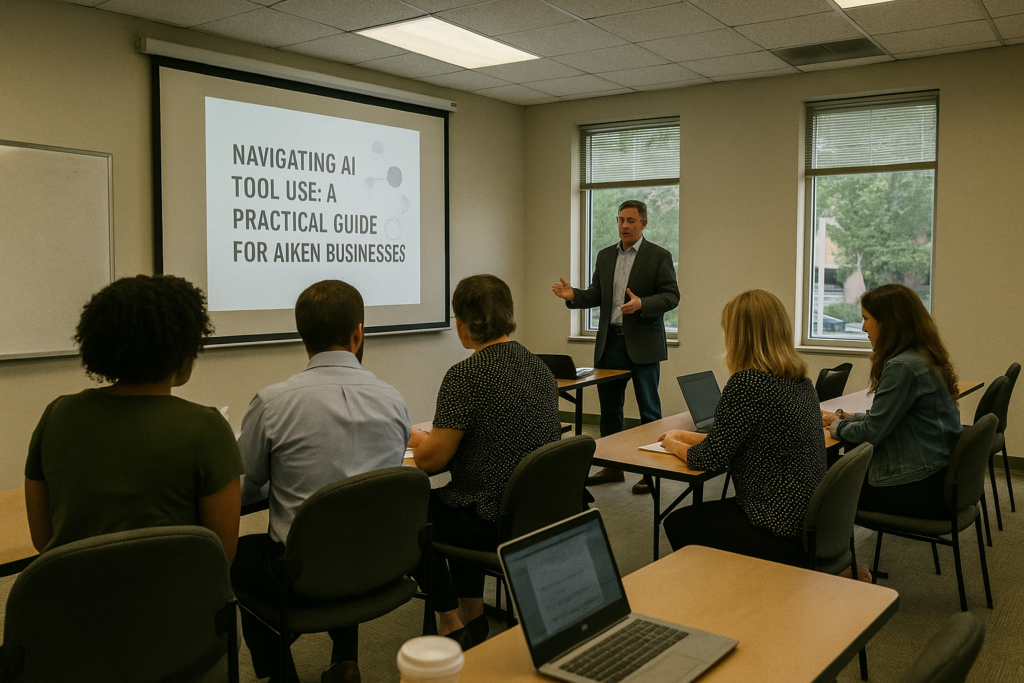
The rapid integration of artificial intelligence into the workplace presents both opportunities and challenges for businesses in the Aiken area. From enhancing productivity to automating tasks, AI tools offer significant potential. However, their adoption necessitates careful consideration of policy frameworks to ensure responsible and effective use by employees.
For companies operating in Aiken and the surrounding Central Savannah River Area (CSRA), establishing clear guidelines for AI tool usage is becoming increasingly critical. These policies should address a range of considerations, from data privacy and security to intellectual property and ethical implications. Without a defined framework, businesses risk inconsistent application, potential misuse of sensitive information, and a failure to fully capitalize on AI’s benefits.
A foundational step for any business is to identify which AI tools are permissible and for what purposes. This involves categorizing tools based on their function and the type of data they handle. For instance, generative AI tools used for content creation may require different oversight than AI-powered analytics platforms that process proprietary company data.
Data security and privacy are paramount. Policies must clearly outline how employee data, customer information, and company proprietary data can be used with AI tools. This includes specifying whether data can be uploaded to external AI platforms, what encryption standards are required, and how data breaches involving AI tools should be handled. Companies should consider the implications of using AI tools that train on user inputs, as this can inadvertently expose sensitive information.
Intellectual property considerations are also vital. When employees use AI tools to generate content, reports, or code, questions arise about ownership. Policies should clarify whether AI-generated content is considered company property and how it should be attributed, if at all. This is particularly important for businesses in sectors like manufacturing or technology, where innovation and proprietary information are key competitive advantages.
Ethical use of AI is another critical component. Businesses should establish guidelines that prevent the use of AI for discriminatory purposes, the generation of misleading information, or any activity that could harm the company’s reputation or violate legal standards. This includes ensuring that AI tools are not used to make employment decisions without human oversight or to perpetuate biases.
Training and education are essential to the successful implementation of any AI policy. Employees need to understand the guidelines, the rationale behind them, and the potential risks associated with AI tool usage. Regular training sessions can help ensure that employees are equipped to use AI tools responsibly and effectively, fostering a culture of informed adoption.
For businesses in Aiken, developing these policies can be approached systematically. A checklist can help ensure all key areas are covered:
1. Tool Inventory and Classification: List all AI tools currently in use or under consideration. Classify them by function (e.g., generative AI, data analysis, automation) and risk level.
2. Permitted Use Cases: Define specific, approved uses for each category of AI tool. Clearly state what is prohibited.
3. Data Handling Protocols: Detail how company, customer, and employee data can be input into or processed by AI tools. Specify requirements for data anonymization or encryption.
4. Security Measures: Outline security protocols for AI tool access, data storage, and incident response related to AI.
5. Intellectual Property Rights: Clarify ownership of AI-generated content and any associated usage rights.
6. Ethical Guidelines: Establish principles for fair, unbiased, and transparent AI usage.
7. Training and Awareness: Plan for ongoing employee education on AI policies and best practices.
8. Policy Review and Updates: Schedule regular reviews to adapt policies as AI technology evolves.
Implementing such a framework is not merely a compliance exercise; it is a strategic imperative for businesses aiming to leverage AI’s power while mitigating its inherent risks. By proactively addressing these issues, companies in the Aiken region can foster innovation and maintain a competitive edge in an increasingly AI-driven landscape.