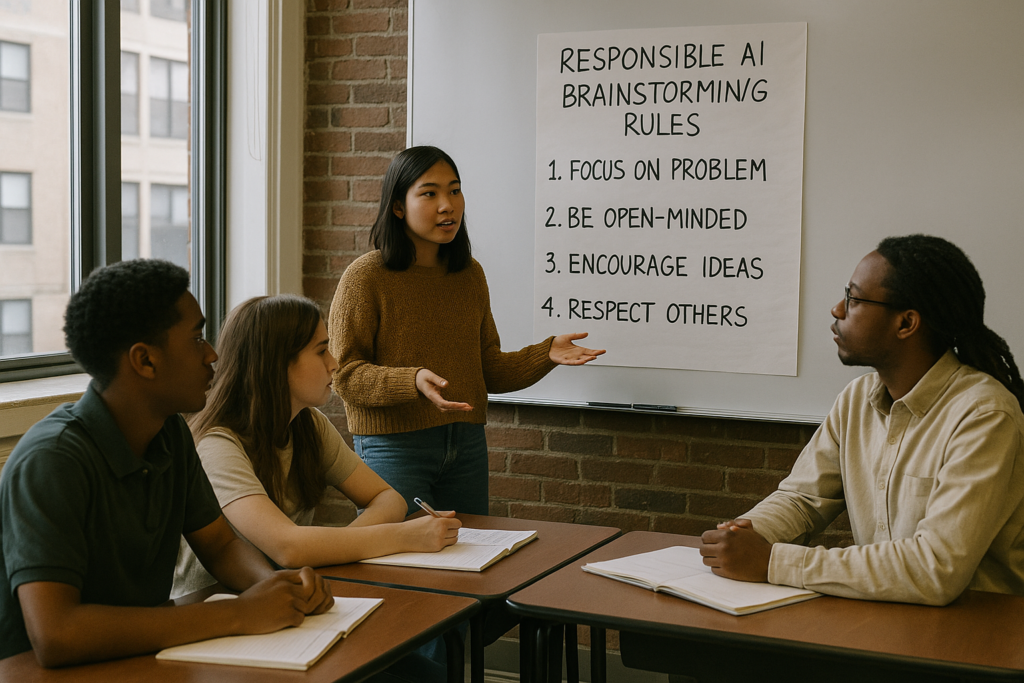
A new framework, “Responsible AI Brainstorming Rules for Students,” offers a practical, evergreen structure for students to consider when using artificial intelligence tools in their academic pursuits. The guidelines are designed to help students understand how to leverage AI effectively while maintaining academic integrity and adhering to institutional policies.
The framework emphasizes that AI tools can be valuable for generating ideas and exploring different approaches to assignments. However, it stresses that students must critically evaluate the information provided by AI and ensure that the final work submitted is their own.
Key tenets of the framework include:
* Utilize AI for Inquiry: Students are encouraged to use AI as a tool for asking questions, exploring concepts, and brainstorming initial ideas. This can help in understanding complex topics or identifying different angles for research.
* Adhere to Class Policy: It is crucial for students to be aware of and follow their instructors’ specific policies regarding the use of AI. Different courses and institutions may have varying guidelines on what is permissible.
* Produce Original Work: The framework strongly advises that while AI can assist in the brainstorming and research phases, the final written or creative output must be the student’s own original work. This means synthesizing information, developing arguments, and expressing ideas in one’s own voice.
This practical checklist is intended to provide a foundational approach to AI use in education. The developers of the framework suggest that students and educators should adapt these guidelines to their specific local rules, conditions, available resources, and professional guidance. This adaptability ensures that the framework remains relevant and effective across diverse educational settings.
The framework is distinct from daily news cycles, offering a stable resource for students and educators seeking to navigate the evolving landscape of AI in academic environments. By providing a clear set of principles, it aims to foster a responsible and ethical approach to integrating AI into the learning process, ensuring that technology serves as a supplement to, rather than a replacement for, original thought and effort.